
Call today to speak to a home expert: 0845 299 6337 *

Can I Build a Granny Annexe in My Garden?

by

So why would you want to build a granny annexe?

Many of us, especially older people, are starting to think differently about how we want to live our lives. Our older relatives still want to keep their independence, but some now also want to be closer to family in case they become less self-sufficient.

At the other end of the age spectrum, many young people cannot afford to move away from home, but want to have more flexibility around how they live.

Multi-generational living may not suit everyone if all the generations are living in the same house though! This is where a ‘granny annexe’ comes in (or grandad!), especially if you or your older relatives have a large garden that has plenty of space.

If you think that a granny annexe might be the solution to your problem, then you will need to look at what you can realistically fit into your space, and then consider planning regulations.
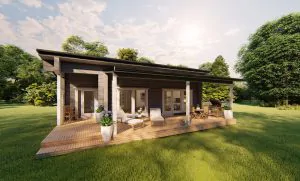
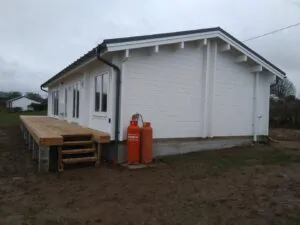
Creating a fully self-contained ‘flat’ in your garden will require planning permission – there’s no [legal] way round that. Permitted development rights (which vary slightly between the regions of the UK) describe what you may be allowed to do, for example to build a home office or gym in your garden. However, if you want your relative to sleep in (i.e. live in) a building then you will definitely need planning permission. Also, an annexe is regarded as ‘ancillary’ to your home, not a separate household, and won’t have a separate address. To get planning permission you will need to apply to your local planning authority and they will want to know things like the size of the annexe, and why you need to build an annexe – as well as who plans to use it. This helps them assess whether there is a genuine need for the building, and that you aren’t planning to run a business from it or try to sell it off as a separate home in the future. Assuming your planning department approves your application, the annexe becomes a legal part of your home; a definite advantage if you decide to sell up. You might feel confident to apply for planning permission yourself but you can also use a planning consultant to help with this (there will be a cost involved, as well as the fee for the planning application itself). The planning application process is fairly straightforward but you’ll need to factor in the time taken to register the application formally, and then the time for the planning department to process your application. This involves publicising the application to neighbours for comment. There is an alternative route which might be worth considering, and that is to construct something that meets the requirements of the Caravan Act (in other words it might be regarded as a structure that could be moved – a mobile home). This may also be relevant if you feel that your application might be rejected (perhaps because of where you plan to site the annexe). The process for this is to apply to your council for a “certificate of lawful development”. This basically says that the council agrees that you don’t need planning permission – but you’ll need your application to have sufficient information for the council to decide this, or it may be refused.
A mobile home granny annexe painted white with gas bottle beside it

So what is a mobile home? It’s defined as a structure which cannot legally be towed on the road (i.e. it is not a touring caravan), but it still needs to be technically feasible to transport it on the road legally. Thus, there are size restrictions on mobile homes. This means that it must be a single or twin unit (i.e. two parts joined together).

A single unit can’t be more than 14ft wide (just over 4m), and no more than 40ft long (about 12m), so it could be transported on a trailer. This is still a perfectly comfortable size for a single person to live in.

A twin unit can’t be more than 22ft 7 (6.8m) wide and 65 ft 7 (20m) long, and has to be able to split into no more than two parts for transportation (although in reality, it would require a feat of logistics to move it). That’s bigger than many new build homes these days, so it could even be suitable for a family.

These size and shape limits may restrict your annexe, but you can of course still have something that is not your average rectangular box – take a look at our ideas here. 

If you’re happy to go down the full planning permission route, then some of our smaller log homes would also make great annexes too.
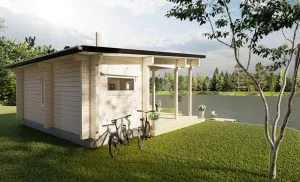
We’ll work with you to create an annexe that’s exactly suited to your needs. And you can look forward to a sustainable, beautiful, warm and secure annexe in your garden. Get in touch to discuss your ideas with us.

0
    Your PDF Downloads
    Your basket is emptyReturn to Portfolio