We’ve been seeing a lot recently about solar panels in relation to the proposed changes in building regulations and the Future Homes Standard. The proposals are aimed at addressing some of the issues around reducing energy use in homes (lowering their carbon footprint and therefore reducing energy bills!). It’s very laudable to explicitly promote the use of solar panels on new homes, and this should have a positive impact on the amount of CO2 emissions generated by the future occupants of new builds.
One of the major contributors to emissions generated from our houses comes from the materials used to build the new homes that we live in. With a massive house building program on the cards, the amount of CO2 that will be generated from all this building is going to be significant. There’s a risk that building lots of new homes will blow the UK’s carbon budget.
Carbon footprint vs carbon storage
Buildings that are made from significant amounts of timber (often called ‘mass timber’) – and log homes of course – can lock up the CO2 that was stored as the trees grew. Although some CO2 is then created as the materials are processed and transported, this is a relatively small amount in comparison to the amount of CO2 that is locked up within the building.
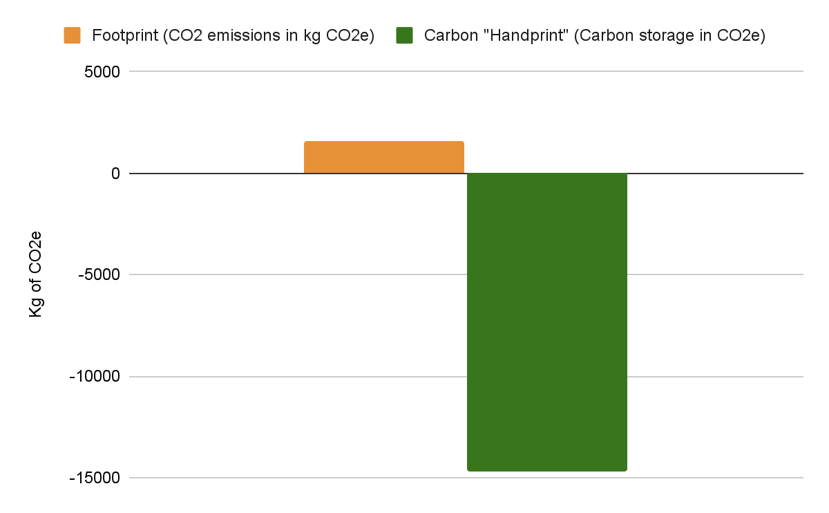
The chart here shows the comparative carbon footprint of various building materials (in orange) compared to the amount of carbon that is stored within them (in green). You can see from this that log homes have a relatively low carbon footprint, but store a huge amount of carbon within them.

what is important to you?
Customers tell us that having low running costs is one of the most important factors when building a new home – they may be currently living in a cold and draughty house that costs a fortune to heat.
But they are also often keen to lower their carbon footprint and leave less of an impact on their family’s future.
If this is important to you as well, we can help you lower your carbon footprint on your self build project. As well as helping with a ‘fabric-first’ approach we can also advise on lower energy options for heating etc. to help lower ongoing energy bills. For example, you might consider adding solar panels and battery storage.

A recent self build home
One of our recent projects was for a four bedroom family home (constructed from a log home kit) with around 220m2 of living area. We calculated that this house used approximately 1,560 kg CO2e in manufacture. However this is significantly offset by the -14,690 kg CO2e that was locked up within the logs used to build it from, which will be stored for the lifetime of the house. And the running costs are very low as well – a fact that is really appreciated by the family in these times of high energy prices.
In Finland, where our log home kits come from, this carbon storage capability is often referred to as the ‘carbon handprint’ of the building. Believe it or not the time that it took to grow the volume of timber that was used in this log home was just 5 seconds!
Forestry in Finland takes up a large part of the country, and much of it is grown as a renewable resource. It is also sustainably harvested, and biodiversity is taken very seriously.